


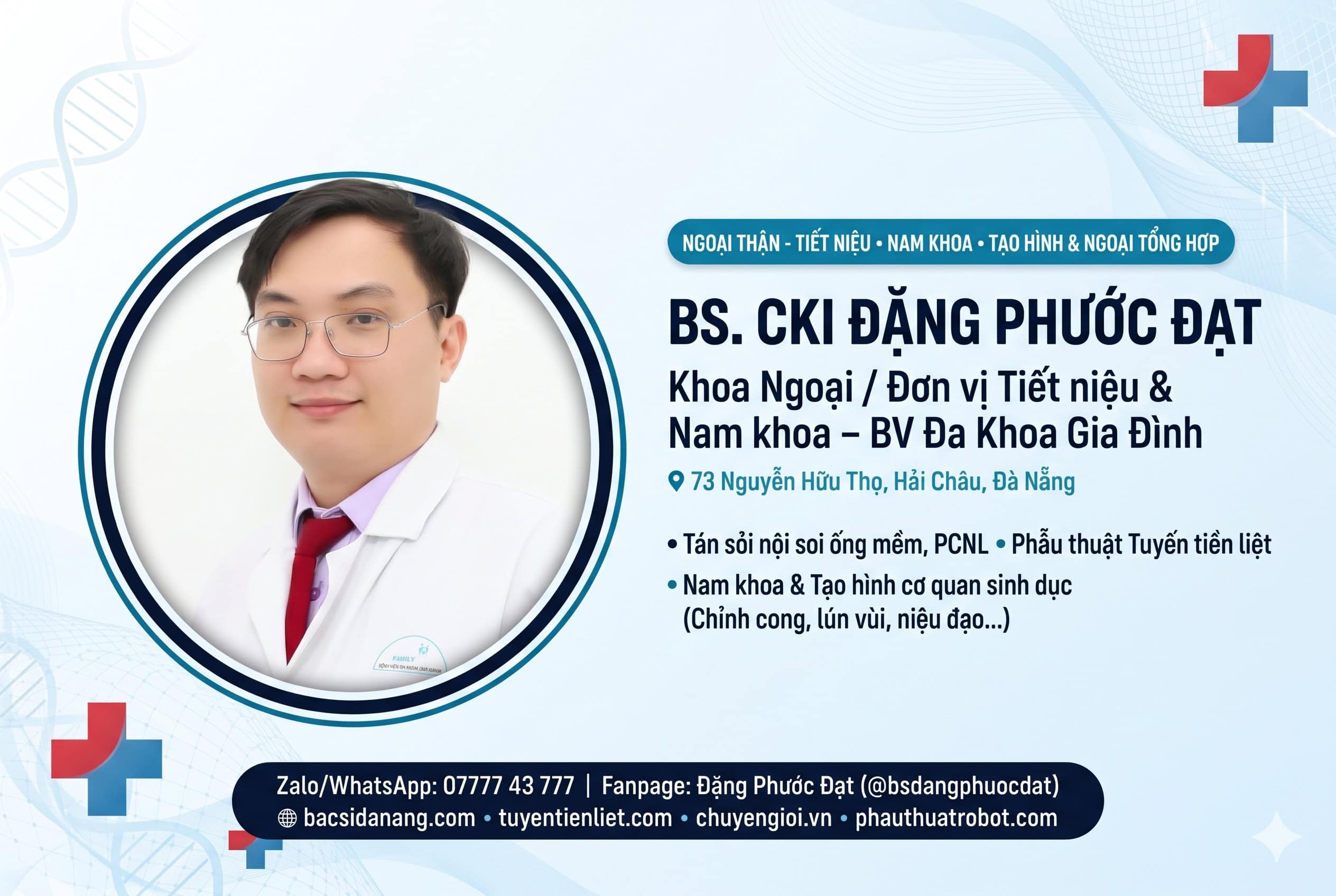
Author & Medical Reviewer: Dr. Dang Phuoc Dat, MD, Specialist Level I – Consultant Urologist, Andrologist & Endourological Surgeon (Family Hospital Da Nang )
Clinical Executive Summary: A Double-J (DJ) Ureteral Stent is an essential temporary internal drainage tube placed from the renal pelvis to the bladder after ureteroscopy (URS/RIRS), Mini-PCNL, or acute obstructive pyelonephritis decompression. Standard polyurethane stents must be removed within 2 to 6 weeks (and never left beyond 3 months) to prevent severe stent encrustation and stone formation. For expats and international travelers in Central Vietnam—including patients who had a stent placed abroad or in another city—Dr. Dang Phuoc Dat provides painless 2-minute outpatient Flexible Cystoscopic DJ Stent Extraction and targeted medical therapy (Alpha-blockers + Beta-3 agonists/antimuscarinics) to relieve stent-related bladder spasms.
1. Why a Double-J Ureteral Stent Is Placed and Optimal Indwelling Timelines (EAU 2026)
Following endourological laser lithotripsy or ureteral dilation, transient mucosal edema or small stone dust fragments can temporarily obstruct urinary flow from the kidney, causing severe post-operative renal colic or hydronephrosis. As outlined in the European Association of Urology (EAU 2026) Urolithiasis Guidelines, the self-retaining proximal and distal coils (“J” curls) of a Double-J stent keep the ureter patent, promote passive ureteral dilation, and allow mucosal healing without stricture formation [1, 2].
CLINICAL VISUAL DIAGRAM: RECOMMENDED DOUBLE-J STENT REMOVAL TIMELINES BY INDICATION
| Surgical / Clinical Indication | Recommended Indwelling Window | Pre-Removal Evaluation Protocol in Da Nang |
|---|---|---|
| 1. Uncomplicated Ureteroscopy (URS) or RIRS Laser Dusting | 1 to 3 weeks (7 – 21 days) | Renal/bladder ultrasound + Urinalysis prior to 2-minute outpatient cystoscopic extraction. |
| 2. Impacted Stone with Edema or Mini-PCNL | 3 to 6 weeks | Plain KUB X-ray + Ultrasound to verify complete stone clearance and zero distal coil encrustation. |
| 3. Laser Endoureterotomy or Laparoscopic Pyeloplasty | 6 to 8 weeks (Strict maximum ≤ 12 weeks for standard polyurethane stents) | Low-dose CT or ultrasound follow-up to confirm resolution of hydronephrosis after stent removal. |
2. Understanding and Relieving “Stent Discomfort” (Ureteral Stent Symptom Questionnaire – USSQ)
Up to 70% of patients with an indwelling Double-J stent experience harmless but bothersome lower urinary tract irritative symptoms caused by mechanical contact of the distal bladder coil against the sensitive trigone and vesicoureteral reflux up the stent lumen during voiding [1, 3]:
- Trigonal Irritation (Urgency, Frequency, & Terminal Suprapubic Spasm): As the bladder empties completely, the detrusor wall contracts onto the lower J-coil, triggering a brief sharp pinch at the end of urination.
- Transient Flank Ache During Urination: Because a DJ stent bypasses the natural anti-reflux flap valve of the ureterovesical junction, voiding bladder pressure transmits briefly up the stent to the renal pelvis for 5 to 10 seconds during micturition.
- Intermittent Pink Urine (Micro/Macro-Hematuria) After Physical Exertion: Walking long distances or climbing stairs causes mild friction between the soft stent coil and bladder mucosa, which clears rapidly with 500 mL of water and rest.
Per the EAU Urolithiasis Guidelines, Dr. Dang Phuoc Dat prescribes a proven dual oral medical regimen—combining a selective Alpha-1 Blocker (Tamsulosin 0.4 mg or Alfuzosin 10 mg daily) with a Beta-3 Agonist (Mirabegron 50 mg) or Antimuscarinic (Solifenacin 5 mg)—which reduces stent-related pain and urinary urgency by 65% to 80%.
3. 4-Column Comparison: Flexible Cystoscopic Removal vs. Rigid Cystoscopy vs. Tethered Extraction String vs. Encrusted Stent Surgery
Why Flexible Cystoscopy Is Preferred for Male Anatomy and Why On-Time Removal Matters
| Clinical Parameter | Flexible / Ultra-Thin Cystoscopic Extraction (2–6 Weeks) | Tethered Extraction String Stent (Short-Term ≤ 7 Days) | Forgotten / Encrusted Stent Management (> 3–6 Months) |
|---|---|---|---|
| Procedure Duration | 60 to 120 seconds actual extraction time | 10 seconds (pulled gently via external nylon tether) | 45 to 90 minutes (Requires combined Holmium Laser Cystolitholapaxy + URS/RIRS) |
| Anesthesia & Patient Comfort | 2% Lidocaine Instillagel urethral lubrication (or optional 5-minute light IV sedation) | No instruments in urethra; slight risk of accidental early dislodgement | Spinal or General Anesthesia in the operating room |
| Pre-Removal Imaging Required | Ultrasound / KUB X-ray to confirm clean coils | Clinical check only | Mandatory Non-Contrast CT to grade proximal & distal stone burden (FECal / KUB score) |
| Hospital Stay | Outpatient (Walk out 15 minutes after removal) | Outpatient | 1 to 3 days inpatient stay |
4. Step-by-Step Painless Double-J Stent Removal in Da Nang for Expats & Travelers
Many international patients have a Double-J stent placed during emergency stone treatment in Bangkok, Singapore, Ho Chi Minh City, or Europe and need safe removal 2 to 4 weeks later while residing or traveling in Da Nang. At Family Hospital Da NangDr. Dang Phuoc Dat, MD, Specialist Level I follows a seamless 3-step outpatient workflow [2, 3]:
- Pre-Extraction Ultrasound & KUB Verification (15 Minutes): Confirms that all residual stone fragments have passed, hydronephrosis has resolved, and no mineral encrustation has formed on the proximal renal coil.
- Intraurethral Anesthetic Gel Dwell Time (5 Minutes): Sterile 2% Lidocaine + Chlorhexidine lubricating gel is gently instilled into the urethra and allowed to take full anesthetic effect on the external urethral sphincter before any instrument is introduced (short IV twilight sedation is also available on request).
- Atraumatic 60-Second Cystoscopic Grasp & Removal: Using an ultra-thin or flexible cystoscope that conforms naturally to the male bulbar-membranous urethra, the distal J-curl is grasped under direct high-definition camera vision and glided smoothly out in less than 1 minute.
⚠️ RED FLAG SYMPTOMS WHILE AN INDWELLING STENT IS IN PLACE
Seek immediate urological evaluation with Dr. Dang Phuoc Dat if you develop any of the following warning signs while carrying a Double-J stent: (1) High fever (≥ 38.5°C), rigors/chills, and cloudy foul-smelling urine (indicating ascending stent-associated pyelonephritis); (2) Severe, unremitting flank pain even when not urinating (suggesting stent lumen occlusion or migration); (3) Frank dark-red hematuria with large blood clots causing difficulty voiding; or (4) Continuous involuntary urinary leakage or visible stent tip protruding from the urethral meatus (distal stent migration past the external sphincter).
5. Frequently Asked Questions (FAQ) With Dr. Dang Phuoc Dat
Question 1: Can Dr. Dang Phuoc Dat remove a Double-J stent that was placed at another hospital or in another country?
Answer: Yes, routinely! Double-J ureteral stents share universal endoscopic retrieval loops worldwide. Simply bring your discharge summary or operative note (or let us perform a quick KUB X-ray/ultrasound on arrival) and we can complete the outpatient removal during a single 45-minute appointment.
Question 2: What happens if a Double-J stent has been accidentally forgotten for 6 months or more?
Answer: According to StatPearls – Endourological Management of Ureterolithiasis (NCBI), a stent left in place for over 4 to 6 months frequently develops hard calcium oxalate or struvite stone encrustations on the upper and lower coils. Forcefully pulling an encrusted stent is strictly contraindicated because it can avulse the ureter. In such cases, Dr. Dat performs a low-dose CT scan and uses Holmium Laser Lithotripsy (Cystolitholapaxy + Flexible RIRS) to dust the encrustation off the stent coils so the stent can be removed safely in one session.
Question 3: What should I expect in the first 24 hours after my stent is removed?
Answer: Most patients feel immediate relief from bladder trigone irritation as soon as the stent is out. Mild urethral warmth during the first 2 to 3 voids and occasional mild flank cramping (due to transient ureteral peristalsis) can occur in the first 24 hours; drinking 2.5 Liters of water and taking the prescribed 3-day oral antibiotic/anti-inflammatory course ensures a smooth recovery.
Medical References (Vancouver Style)
- Skolarikos A, Jung H, Neisius A, et al. EAU Guidelines on Urolithiasis: Perioperative Stenting, Medical Management of Stent-Related Symptoms, and Encrusted Stent Protocols. Arnhem: European Association of Urology; 2026. (EAU Guidelines)
- Glazer K, Brea IJ, Vaitla P. Ureterolithiasis and Ureteral Stent Management. In: StatPearls [Internet]. Treasure Island (FL): StatPearls Publishing; 2024/2025. (NCBI Bookshelf)
- Ministry of Health of Vietnam. Decision No. 4068/QD-BYT on Clinical Guidelines for Diagnosis and Treatment of Nephrology and Urology Diseases. Hanoi; 2016. (Vietnam Ministry of Health)
Dr. Dang Phuoc Dat, MD, Specialist Level I – Consultant Urologist, Andrologist & Endourological Surgeon (Over 10 years of clinical surgical experience in Da Nang).
📞 Direct English Hotline / Zalo / WhatsApp: 07777 43 777 | Zalo Chat: zalo.me/0777743777 | Websites: bacsidanang.com & tuyentienliet.com
Select any symptoms you are currently experiencing to see your recommended clinical triage level before messaging Dr. Dang Phuoc Dat:

ĐẦU TƯ NGHIÊM TÚC