


Author & Medical Reviewer: Dr. Dang Phuoc Dat, MD, Specialist Level I – Consultant Urologist, Andrologist & Reconstructive Surgeon.
Quick clinical summary: Vacuum-assisted Mini-PCNL (VmPCNL) combines a 14–18 Fr miniature percutaneous tract with continuous active suction to maintain low intrarenal pressure, reducing 48-hour postoperative SIRS from 21.8% to 8.6% (p = 0.036), shortening operative time, and outperforming flexible ureteroscopy (RIRS) in single-session stone clearance and cost per stone-free patient for kidney stones ≥15 mm.
48h Post-op SIRS (VmPCNL)
8.6% vs 21.8%
Independently lowers postoperative SIRS risk (aOR 0.44; p = 0.041) with 0% sepsis vs standard Mini-PCNL (Piyawannarat 2026).
Final SFR ≥15 mm (Mini-PCNL vs RIRS)
94.7% vs 88.7%
Single-session SFR 70.2% vs 43.6% (p < 0.0001) and absolute 0 mm SFR 82.5% vs 74.2% on 30-day CT (Suraci 2025/2026).
Cost / Absolute Stone-Free Pt
€3,825 vs €4,971
23% lower micro-costing expenditure per completely stone-free patient due to fewer repeat sessions (1.35 vs 1.68; p = 0.002).
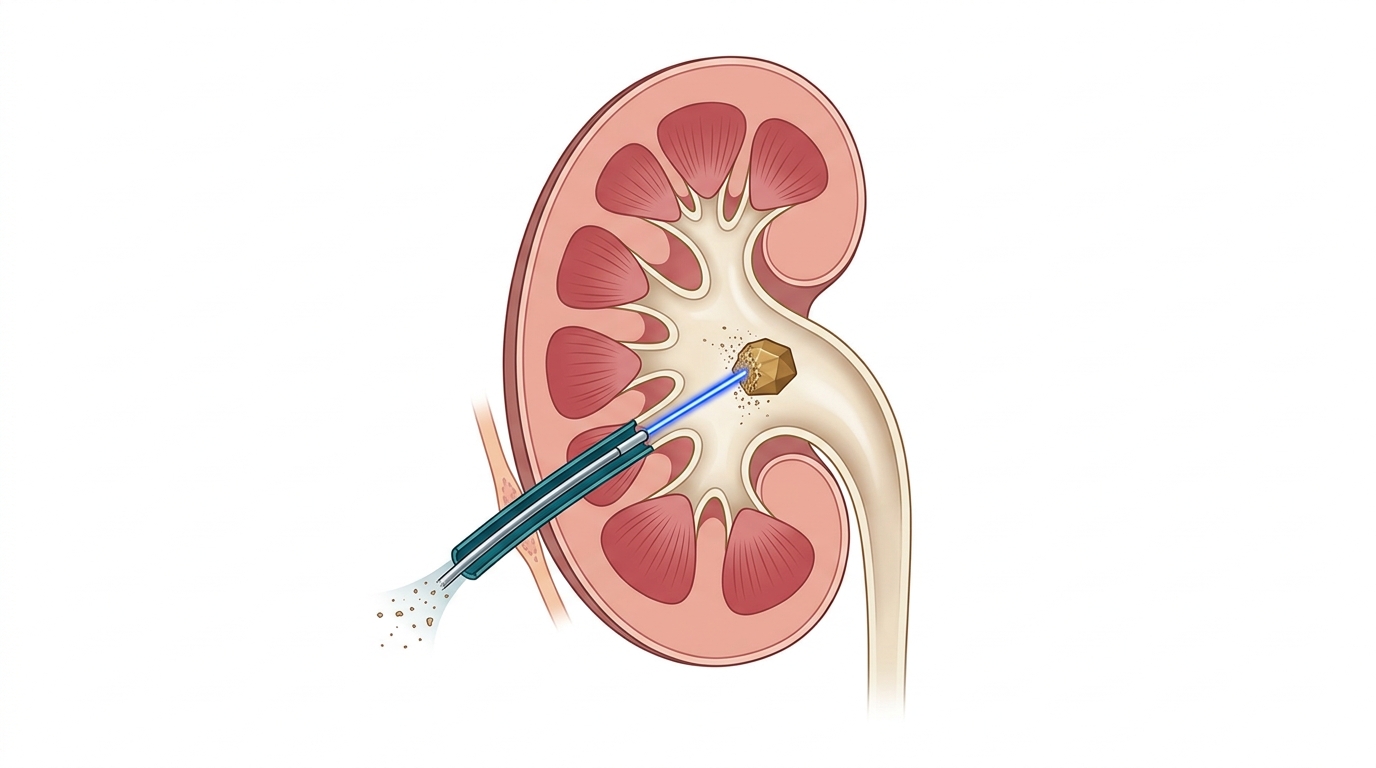
How a 14–18 Fr miniature tract with continuous suction transforms percutaneous stone surgery 
Coronal kidney illustration: a slender 14–18 Fr suction access sheath enters through a single posterior lower calyx, enabling high-power Holmium or Thulium laser fragmentation while continuous negative-pressure outflow clears stone dust and maintains low intrarenal pressure.
Why active suction solves the historical limitation of conventional Mini-PCNL
Both the EAU Urolithiasis Guidelines (2025/2026) and the AUA Surgical Stones Guideline (2026) endorse percutaneous nephrolithotomy (PCNL) as first-line therapy for kidney stones larger than 20 mm, while explicitly recognizing Mini-PCNL as an effective option for 10–20 mm calculi. Miniaturizing the access tract from 24–30 Fr down to ≤18 Fr reduces parenchymal injury and bleeding, yet narrow non-suction sheaths can restrict irrigation outflow, elevating intrarenal pressure (IRP) and promoting pyelovenous backflow and postoperative systemic inflammatory response syndrome (SIRS) (Zhong, Yuen & Zeng, 2026).
In a 2026 real-world cohort of 136 patients (58 VmPCNL with a 14/16 Fr ClearPetra suction sheath vs 78 standard Mini-PCNL, mean stone size ~26 mm) from Ramathibodi Hospital, Piyawannarat et al. (2026) demonstrated that VmPCNL significantly lowered 48-hour postoperative SIRS from 21.8% to 8.6% (p = 0.036), reduced median operative time from 115 to 90 minutes (p = 0.038), shortened length of stay (p = 0.012), and achieved 0% sepsis (vs 1.3%). Multivariable regression confirmed VmPCNL as an independent protective factor against SIRS (aOR 0.44, 95% CI 0.19–0.98; p = 0.041), whereas a positive preoperative urine culture independently increased SIRS risk (aOR 2.60; p = 0.045).
VmPCNL cuts postoperative SIRS by more than half while maintaining high stone clearance
Real-world cohort of 136 patients (58 VmPCNL vs 78 SmPCNL, mean stone diameter ~26 mm). Source: Piyawannarat et al., Res Rep Urol (June 2026, PMC13281880).
Head-to-head comparison: Mini-PCNL vs RIRS and Standard PCNL for 15–40 mm stones
For kidney stones measuring 15–20 mm or lower-pole calculi with unfavorable anatomy, Suraci et al. (2025/2026) evaluated 119 patients with stones ≥15 mm (57 suction Mini-PCNL vs 62 RIRS). Although RIRS yielded shorter operative times (87 vs 113 min) and hospital stays (1.22 vs 2.24 days), suction Mini-PCNL delivered substantially higher single-session stone-free rates (70.17% vs 43.55%; p < 0.0001), higher final SFR ≤4 mm (94.74% vs 88.71%; p = 0.043), and higher absolute 0 mm SFR (82.45% vs 74.20%; p = 0.035) on 30-day CT.
For larger stones (~30 mm, >1,300 HU), a 180-patient prospective Trifecta study by Ahmed et al. (2025) showed Mini-PCNL cut overall Clavien–Dindo complications from 17.77% (5.6% Grade III) to 6.66% (0% Grade III) (p = 0.02), though non-suction pneumatic Mini-PCNL had lower clearance (76.7% vs 93.3%) and more auxiliary procedures (20% vs 4.4%). Adding active suction and laser lithotripsy bridges this clearance gap, which is now being formally tested in an international 20-center, 960-patient noninferiority RCT (NCT05088213, 2026).
Three anatomical kidney stone morphologies where Mini-PCNL provides decisive advantages
Left: Solitary renal pelvis stone >20 mm (first-line for suction Mini-PCNL); Center: 10–20 mm lower-pole stone with narrow infundibulum and steep angle (higher single-session clearance than RIRS/ESWL); Right: Complex branched staghorn stone (Mini-PCNL or combined ECIRS).
Suction Mini-PCNL outperforms RIRS in single-session and absolute 0 mm clearance for stones ≥15 mm
30-day non-contrast CT outcomes across 119 patients with kidney stones ≥15 mm. Source: Suraci et al., J Clin Med (2025/2026, PMC12786861).
Clinical comparison matrix: VmPCNL vs Standard PCNL vs RIRS
| Clinical Parameter | Suction Mini-PCNL (VmPCNL) | Standard PCNL | Flexible Ureteroscopy (RIRS) |
|---|---|---|---|
| Access tract size | 14–18 Fr (~5 mm) with continuous negative-pressure suction. | 24–30 Fr (~8–10 mm). | Zero skin incision (natural retrograde urinary tract). |
| Optimal stone burden | 15–40 mm, complex lower-pole, hard stones >1,000 HU. | Very large >30–40 mm or dense staghorn calculi. | <20 mm stones or patients on anticoagulation. |
| Stone-free rate (SFR) | 86.2%–94.7% (70.2% single-session for ≥15 mm). | 86%–93.3% (highest for massive stone loads). | 88.7% after mean 1.68 sessions (43.6% single-session). |
| Bleeding & infection profile | Low transfusion (1.7%); SIRS 8.6%, sepsis 0%. | Higher blood loss & Clavien ≥III rate (5.6%). | Minimal bleeding risk; higher staged-procedure rate. |
| Hospital stay & economics | 2–3 days; 20–23% lower cost per stone-free patient vs RIRS. | 3–5 days; greater postoperative flank pain. | 1–2 days; higher disposable ureteroscope cost. |
Micro-costing analysis: Why Mini-PCNL is more cost-efficient for ≥15 mm stones
Although a single Mini-PCNL admission has slightly higher upfront OR and inpatient costs than RIRS (€2,336 vs €2,197), single-use flexible ureteroscopes drive significantly higher disposable expenditure in RIRS (€1,097 vs €806; p = 0.004) (Suraci et al., 2025/2026). Once adjusted for retreatment sessions (1.35 procedures for Mini-PCNL vs 1.68 for RIRS; p < 0.001), total expenditure per completely stone-free patient drops to €3,825 for Mini-PCNL vs €4,971 for RIRS (p = 0.002).
Mini-PCNL lowers hospital cost per stone-free patient by 20–23% compared with RIRS
Hospital micro-costing analysis (EUR) covering disposables, OR minutes, imaging, and inpatient stay across 119 cases ≥15 mm. Source: Suraci et al., J Clin Med (2025/2026, PMC12786861).
⚠️ Contraindications & Postoperative Red Flags
- Absolute contraindications: Active untreated urinary tract infection or pyonephrosis (requires urgent drainage first), uncorrected coagulopathy, pregnancy, or renal malignancy along the access tract.
- Seek urgent care after surgery for: High fever >38.5°C with rigors, persistent bright-red hematuria with blood clots, worsening flank pain, or dizziness/hypotension.
Clinical blind spots and unresolved evidence gaps
- Pending definitive multicenter RCT: Most VmPCNL data remain observational; the 960-patient international noninferiority RCT (NCT05088213) published its protocol in 2026 and will provide definitive Level 1 evidence for 2–4 cm stones.
- Stone density (HU) drives clearance independently: Multivariable analysis by Suraci et al. (2025/2026) showed each 100 HU increase reduced stone-free odds by 47% (OR 0.53; p = 0.002).
- Direct real-time IRP monitoring remains scarce: Future prospective trials incorporating continuous intrarenal pressure sensors are needed to directly validate the hemodynamic mechanism behind VmPCNL's lower SIRS rate (Piyawannarat 2026).
Frequently asked questions about vacuum-assisted Mini-PCNL
Should an 18 mm kidney stone be treated with Mini-PCNL or RIRS?
Both are safe and effective. If the stone sits in a steep lower calyx, has high density (>1,000 HU), and maximizing single-session stone clearance is the priority, suction Mini-PCNL holds a clear advantage. If you cannot pause anticoagulation or strongly prefer avoiding a 5 mm flank incision, RIRS is preferred.
Is a nephrostomy drainage tube always required after Mini-PCNL?
No. In uncomplicated cases with complete stone clearance and minimal bleeding, tubeless Mini-PCNL avoids an external flank tube altogether, leaving only an internal Double-J ureteral stent for about 2 weeks and allowing discharge in 2–3 days.
What preoperative preparation lowers infection risk before Mini-PCNL?
Every patient requires a non-contrast CT scan to map stone burden and Hounsfield density plus a preoperative urine culture. Any positive culture must be treated with culture-directed antibiotics for 5–7 days prior to surgery to minimize postoperative SIRS.
References
- Piyawannarat S, Sirisopana K, Kongchareonsombat W, et al. Vacuum-Assisted Mini-PCNL is Associated with Lower Postoperative SIRS: A Real-World Cohort Study. Res Rep Urol. 2026;18:618289. PMC13281880.
- Suraci PP, Fuschi A, Pastore AL, et al. Comparison Between RIRS and Mini-PCNL in the Treatment of Kidney Stones Exceeding 15 mm: Outcome Evaluation and Cost Analysis. J Clin Med. 2025/2026;15(1):177. PMC12786861.
- Zhong W, Yuen SKK, Zeng G, et al. Suction mini-percutaneous nephrolithotomy versus standard percutaneous nephrolithotomy for 2–4 cm kidney stones: multicenter RCT protocol (NCT05088213). World J Urol. 2026;44(1):206. PMC12946343.
- Ahmed I, Ali L, Haseeb A, et al. Comparison of Trifecta Outcomes in Standard Versus Mini Percutaneous Nephrolithotomy for Renal Stone Management. Cureus. 2025;17(3):e80328. PMC11980021.
- EAU Guidelines on Urolithiasis (2025/2026 Edition). Uroweb EAU; AUA Surgical Management of Kidney and Ureteral Stones Guideline (2026). AUA 2026 PDF.
Dr. Dang Phuoc Dat, MD, Specialist Level I – Consultant Urologist, Andrologist & Reconstructive Surgeon.
📞 Hotline / Zalo / WhatsApp: 07777 43 777
ĐẦU TƯ NGHIÊM TÚC