


Author & Medical Reviewer: Dr. Dang Phuoc Dat, MD, Specialist Level I – Consultant Urologist, Andrologist & Reconstructive Surgeon.
Quick clinical summary: Retrograde Intrarenal Surgery with a Flexible and Navigable Suction Ureteral Access Sheath (RIRS with FANS) represents a paradigm shift from passive fragment drainage to active intrarenal stone aspiration. By navigating a tip-flexible sheath (218–277° deflection) across the ureteropelvic junction directly into renal calyces under continuous negative pressure, FANS elevates immediate Day-1 stone-free rates from 54.5% to 79.1% (93.5% at 30 days), reduces overall complications by 52%, and lowers secondary reinterventions by 74% across 3,030 pooled patients.
Day-1 & 30-Day SFR (FANS)
79.1% → 93.5%
Significantly outperforms conventional UAS (54.5% Day-1; 82.7% Day-30; p < 0.001) across 3,030 patients (Mittal et al., 2026).
52% Fewer Complications
9.7% vs 20.2%
Lowers postoperative fever >38°C from 13.5% to 4.5% (RR 0.34) and SIRS from 14.9% to 7.1% (RR 0.48).
74% Lower Reintervention
5.6% vs 16.1%
Cuts basket extraction needs nearly in half (18.3% vs 34.6%) and reduces repeat procedures (RR 0.26; NNT = 9).
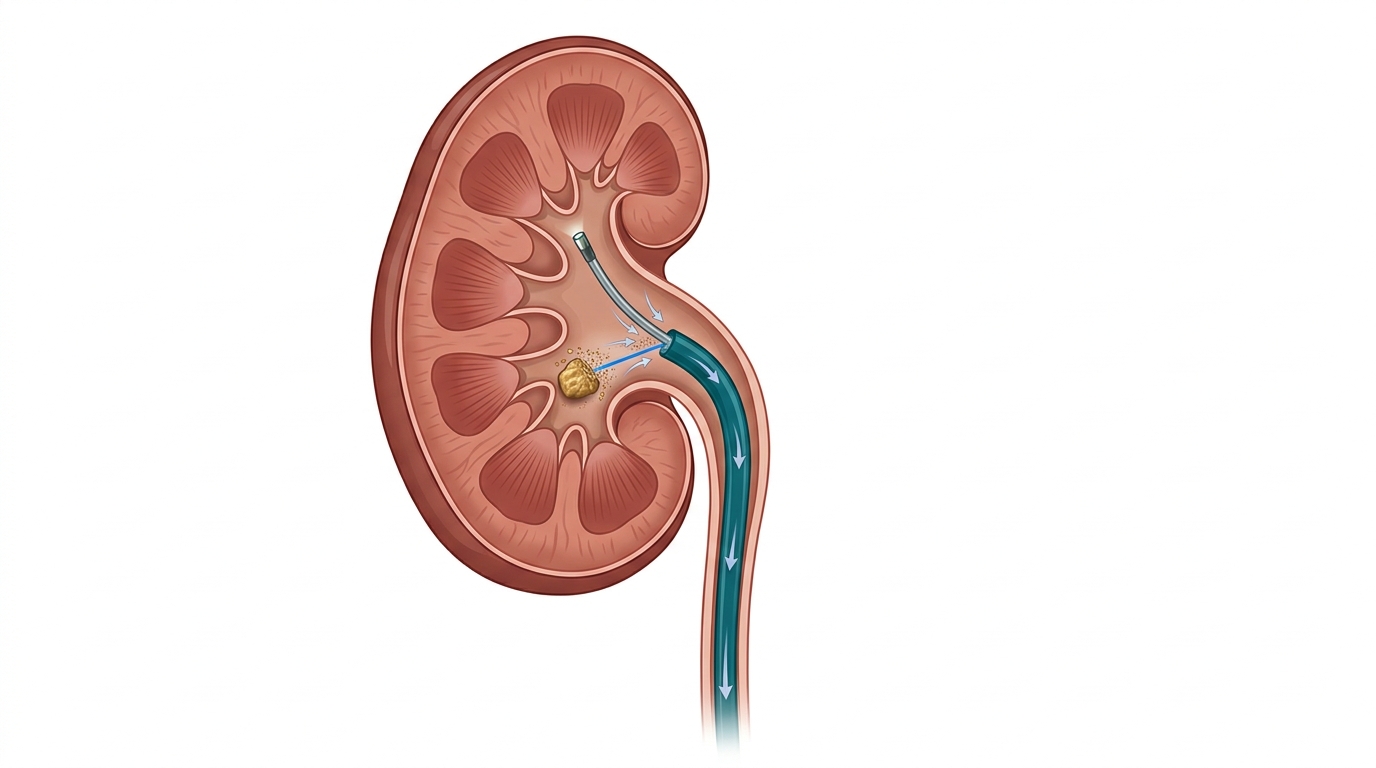
Mechanism of RIRS with FANS: Tip-flexible suction sheath navigating directly into a lower renal calyx 
Coronal kidney view: the spring-reinforced flexible tip of the FANS sheath bends alongside the digital flexible ureteroscope past the ureteropelvic junction (PUJ) into the target calyx, aspirating laser-pulverized stone dust and fluid under continuous negative pressure.
From passive drainage to active intrarenal aspiration in flexible ureteroscopy
Although conventional ureteral access sheaths (C-UAS) are used in 93.2% of modern RIRS procedures, their rigid distal tip must remain positioned in the proximal ureter below the ureteropelvic junction (PUJ), where the PUJ acts as a functional valve restricting fluid and fragment egress (Mittal et al., 2026; Menzies-Wilson et al., 2025/2026). During laser lithotripsy of larger or lower-pole stones, swirling stone dust obscures endoscopic vision ("snowstorm effect"), 21%–59% of residual fragments trigger clinical events within 5 years, and intrarenal pressure (IRP) frequently spikes above 30–40 mmHg, driving pyelovenous backflow and infectious morbidity.
Flexible and Navigable Suction Ureteral Access Sheaths (FANS) overcome these barriers by pairing a 6–8 cm bendable distal tip (capable of 218°–277° deflection) with an adjustable negative-pressure suction port (100–200 mmHg). Navigating the sheath tip directly into the renal pelvis and individual calyces bypasses the PUJ valve, clears 2–3 mm stone fragments in real time without repeated basket passes, and keeps the collecting system decompressed (PMC13428100; Xu et al., 2026).
Anatomical comparison: Conventional rigid-tip UAS vs Flexible and Navigable Suction Sheath (FANS)
Left (Conventional UAS): the sheath stops below the PUJ, leaving lower-pole fragments and pressurized fluid trapped inside the calyx; Right (FANS): the flexible sheath bends directly into the calyx with the ureteroscope, evacuating stone dust and collapsing intrarenal pressure.
2026 Meta-analysis & Trial Sequential Analysis (3,030 patients): Where FANS delivers the greatest gain
An April 2026 systematic review, meta-analysis, and Trial Sequential Analysis (TSA) of 15 studies (11 RCTs and 4 prospective cohorts; 3,030 patients: 1,342 FANS vs 1,688 C-UAS) by Mittal et al. (2026) confirmed that cumulative evidence reached 106.4% of the required information size (Z = 3.82; Bayesian posterior probability of FANS superiority = 99.8%):
- Superior stone-free rates at every time point: Immediate Day-1 SFR rose by 47% relative risk from 54.5% to 79.1% (RR 1.47, 95% CI 1.23–1.76; p < 0.001; NNT = 6), with sustained superiority at 30 days (93.5% vs 82.7%; RR 1.13; p < 0.001) and 3 months (96.2% vs 88.4%; RR 1.09; p < 0.001). Complete 0 mm CT clearance reached 68.4% vs 42.3% (p < 0.001), with 98.1% vs 91.8% stone volume clearance.
- Pronounced advantage for stones >15–20 mm and density ≥1,000 HU: Subgroup interaction testing confirmed that FANS efficacy scales with stone complexity (p = 0.002): minimal difference for <10 mm stones (78.5% vs 71.3%; RR 1.10), rising sharply for 15–20 mm stones (85.7% vs 52.3%; RR 1.64; NNT = 3), >20 mm stones (92.3% vs 43.1%; RR 2.14; NNT = 2), and hard stones ≥1,000 HU (81.2% vs 41.8%; RR 1.94; NNT = 3).
- Inferior calyx calculi (<20 mm): In a dedicated lower-pole cohort (n = 111, mean stone density >1,000 HU) by Xu et al. (Jan 2026), FANS improved stone clearance to 96.23% vs 81.03% (p = 0.017) while shortening operative time from 46.59 to 37.81 minutes (p < 0.001).
- Synergy with Thulium Fiber Laser (TFL): In the prospective EAU Section of Urolithiasis multicenter study by Gauhar, Traxer et al., combining FANS with TFL yielded a median lasing time of 18 minutes (median OR time 49 minutes), 97.2% Grade A+B stone-free status, 3.3% low-grade fever, and 0% sepsis (TFL independently increased Grade A zero-fragment clearance, OR 1.83).
FANS widens the stone-free gap most dramatically in 15–20 mm and dense (≥1,000 HU) stones
Pooled data across 15 studies (11 RCTs, 4 prospective cohorts; n = 3,030). Source: Mittal et al., Urol Res Pract (April 2026, PMC13428100).
Over 50% reduction in overall complications, postoperative fever, SIRS, and reinterventions
FANS reduces overall complications by 52% (9.7% vs 20.2%), postoperative fever by 66% (4.5% vs 13.5%), and secondary reinterventions by 74% (5.6% vs 16.1%). Source: Mittal et al. (2026, PMC13428100).
Oxford 2026 fluid-dynamics model: Matching scope and FANS diameters to keep intrarenal pressure ≤30 mmHg
Ex vivo and mathematical fluid-dynamics modeling from the University of Oxford by Menzies-Wilson, Turney et al. (BJU International, 2025/2026) revealed that once a FANS tip crosses the PUJ into the renal pelvis, fluid outflow resistance is governed by the annular cross-sectional area between the ureteroscope outer diameter and the FANS inner lumen:
- The optimal outflow-resistance sweet spot (0.29–0.39 mmHg/mL/min): Pairing a 7.5 Fr ureteroscope with an 11/13 Fr FANS (resistance 0.39) or a 6.3 Fr slim ureteroscope with a 10/12 Fr FANS (resistance 0.29) permits safe irrigation flow rates up to 65–85 mL/min (13–17× standard gravity irrigation of ~5 mL/min) to dissipate high-power laser heat and flush dust while keeping intrarenal pressure (IRP) ≤30 mmHg even without active suction.
- Hazards of mismatched diameters: Placing a bulky 9.5 Fr scope inside an 11/13 Fr FANS spikes outflow resistance to 1.90 mmHg/mL/min, capping safe flow at ~15 mL/min and breaching the 30 mmHg pyelovenous backflow threshold at just 100 mmHg irrigation pressure. Conversely, a 6.3 Fr scope in an 11/13 Fr FANS (resistance 0.18) requires ≥40 mL/min just to distend the renal pelvis (IRP ≥10 mmHg), which can cause excessive retropulsion of small stones.
Maximum safe irrigation flow rate (maintaining IRP ≤30 mmHg) across ureteroscope and FANS pairings
Asterisks (*) denote the optimal 0.29–0.39 mmHg/mL/min outflow-resistance pairings (7.5 Fr scope + 11/13 Fr FANS or 6.3 Fr scope + 10/12 Fr FANS). Source: Menzies-Wilson et al., University of Oxford, BJU Int (2025/2026, PMC12950934).
Clinical decision matrix: RIRS with FANS vs Conventional RIRS vs Suction Mini-PCNL
| Clinical Parameter | RIRS + FANS | Conventional RIRS (C-UAS) | Suction Mini-PCNL (VmPCNL) |
|---|---|---|---|
| Access & evacuation mechanism | Natural orifice (scarless); 218–277° bendable sheath aspirates dust directly inside calyces. | Natural orifice; rigid tip below PUJ, passive outflow + manual basket extraction. | 5 mm percutaneous flank tract (14–18 Fr) with continuous vacuum suction. |
| Optimal stone indication | 10–20 mm stones (selected 20–25 mm), lower-pole IPA >35°, dense stones ≥1,000 HU. | Small stones <10–15 mm with lower density <1,000 HU. | Large stones >20–40 mm, staghorn calculi, or steep lower pole IPA <30–35°. |
| Stone-free rate (SFR) | Day 1: 79.1% · Day 30: 93.5% · 3 Mo: 96.2%. | Day 1: 54.5% · Day 30: 82.7% · 3 Mo: 88.4%. | Day 30: 86.2%–94.7% (superior for >20–30 mm burden). |
| Post-op fever & SIRS | Fever: 4.5% · SIRS: 7.1% (IRP kept <30 mmHg). | Fever: 13.5% · SIRS: 14.9%. | SIRS: 8.6% (VmPCNL) vs 21.8% (non-suction Mini-PCNL). |
| Reintervention & discharge | Reintervention: 5.6%; 68.4% discharged within 24h. | Reintervention: 16.1%; 58.7% discharged within 24h. | 2–3 day stay; slightly greater hemoglobin drop than RIRS. |
⚠️ Anatomical Contraindications & Postoperative Red Flags
- Absolute contraindications: Untreated acute urinary tract infection or obstructive pyonephrosis (requires urgent drainage first), or tight ureteral stricture preventing safe sheath advancement (primary insertion failure occurs in 2.2%–3.1% and warrants staged pre-stenting).
- Steep lower-pole boundary: When the infundibulopelvic angle is severely acute (IPA <30°–35°) with a narrow long infundibulum, forced deflection risks scope damage (1.1%); Suction Mini-PCNL is preferred.
- Postoperative emergency warning signs: Fever >38.5°C with chills, refractory renal colic, bright-red hematuria with clots, or oliguria.
Clinical blind spots and unresolved evidence gaps
- High heterogeneity and short follow-up (1–3 months): In Mittal et al. (2026), Day-1 SFR heterogeneity was considerable (I2 = 89.3%) due to pooling diverse sheath designs, and 1–3 month follow-up is too short to evaluate late ureteral stricture rates at 6–12 months.
- The open-vent "air off-valve" effect: Menzies-Wilson et al. (Oxford, 2026) demonstrated that when the FANS pressure-vent remains uncovered, wall suction preferentially aspirates room air rather than lowering IRP; true negative pressure requires active thumb occlusion of the vent and proper scope-to-sheath sizing.
- Increased fluoroscopy time and brand-to-brand variation: FANS procedures used more fluoroscopy time than conventional UAS (68.2 vs 26.0 seconds; p < 0.001) to verify calyceal tip navigation (PMC13428100), and 2026 benchtop comparisons (PMC12923460) show significant differences in suction efficiency and deflection force across commercial 12/14 Fr FANS models (Dornier Hoover, Wellead ClearPetra, Vathin).
Frequently asked questions about RIRS with FANS
How does RIRS with FANS differ from standard flexible ureteroscopy?
Standard RIRS uses a rigid-tip sheath parked below the kidney, relying on passive washout and weeks of spontaneous fragment passage (only 54.5% immediate clearance). FANS uses a flexible suction sheath that bends directly into each renal calyx alongside the laser scope to vacuum out stone dust and 2–3 mm fragments immediately during surgery, raising Day-1 clearance to 79.1% and cutting fever risk by two-thirds.
Is preoperative Double-J stenting always required before RIRS with FANS?
No. In the 2026 meta-analysis subgroup of 1,314 non-pre-stented patients, FANS still achieved an 81.1% immediate stone-free rate (vs 59.4% with conventional sheaths, RR 1.37), especially when 10/12 Fr or 11/13 Fr sheaths are paired with slim 6.3–7.5 Fr digital ureteroscopes. Staged pre-stenting is reserved for patients with anatomically narrow ureters.
How quickly can patients recover and return to work after RIRS with FANS?
Because the entire procedure is performed through the natural urinary tract without skin incisions, 68.4% of patients are discharged within 24 hours (mean stay 1.73 days) and typically resume desk work and normal daily activities within 2–3 days.
References
- Mittal A, Subramanyam AD, Panwar VK, et al. Comparison of Flexible and Navigable Suction Ureteral Access Sheath Versus Conventional Ureteric Access Sheath in RIRS: A Systematic Review and Meta-Analysis (15 studies, n = 3,030). Urol Res Pract. 2026;52:e25119. PMC13428100.
- Xu XY, Tu HJ, Cao LH, et al. Advancing stone treatment: the transformative impact of flexible navigable suction ureteral access sheath (FANS) for inferior calyx calculi (<2 cm). Front Urol. 2026;5:1695781. PMC12891835.
- Menzies-Wilson R, Williams J, Turney B, et al. Flexible and navigable suction access sheaths: balancing sheath and scope size for desired flows. BJU Int. 2025/2026;137(Suppl 3):S60–S70. PMC12950934.
- Gauhar V, Traxer O, Castellani D, et al. Could Use of a Flexible and Navigable Suction Ureteral Access Sheath Be a Potential Game-changer in Retrograde Intrarenal Surgery? Outcomes at 30 Days from a Large Prospective Multicenter Study by the EAU Urolithiasis Section. Eur Urol Focus. 2024;10(6):975–982. PubMed PMID 38789313.
- Suction, flexion, and noise profile of three flexible and navigable suction ureteral access sheaths. 2026. PMC12923460; EAU Guidelines on Urolithiasis (Uroweb EAU 2026).
Dr. Dang Phuoc Dat, MD, Specialist Level I – Consultant Urologist, Andrologist & Reconstructive Surgeon.
📞 Hotline / Zalo / WhatsApp: 07777 43 777
ĐẦU TƯ NGHIÊM TÚC