


By Dr. Dang Phuoc Dat (Specialist in Urology)
Are you seeking advice from a Urologist or Andrologist? Contact us to schedule a consultation.
What is Ultrasound-Guided Mini-PCNL?
Mini-PCNL (Miniaturized Percutaneous Nephrolithotomy) is an advanced, minimally invasive procedure for treating kidney stones. This article explores the definition, benefits, risks, and recovery process associated with ultrasound-guided Mini-PCNL laser lithotripsy.
Understanding Urinary Stones
Urinary stones (urolithiasis) are a common condition globally, affecting between 1% and 15% of the population, with kidney stones being the most prevalent form. Most urinary stones originate in the kidneys. While some stones remain asymptomatic, untreated stones can grow over time, potentially causing significant kidney damage.
Anatomy of the Urinary Tract:
- Kidneys: Filter blood to produce urine.
- Ureters: Two small tubes that carry urine from the kidneys to the bladder.
- Bladder: Stores urine.
- Urethra: The tube through which urine is expelled from the body.
When a stone obstructs the urinary tract and causes pain or complications, medical intervention is strongly recommended.
What is Ultrasound-Guided Mini-PCNL?
Percutaneous Nephrolithotomy (PCNL) is an endoscopic surgery used to remove stones directly from the kidney.
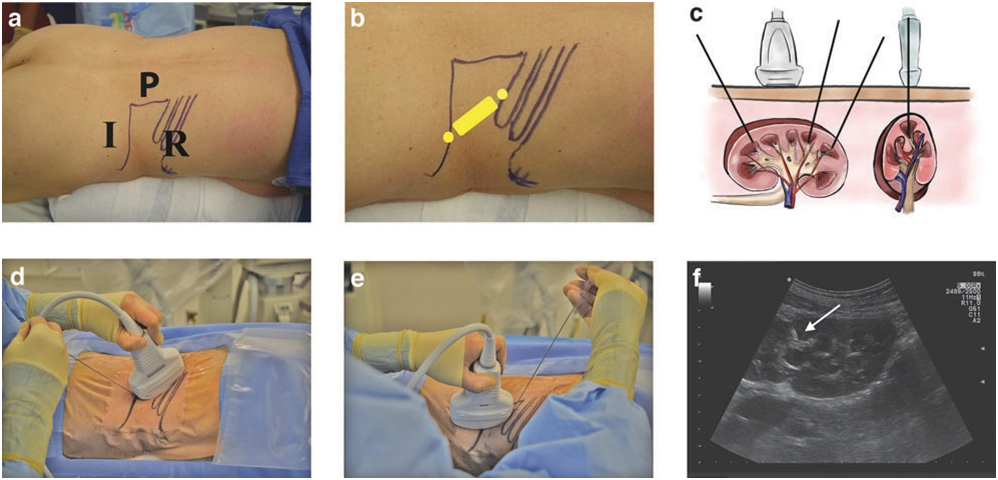
In Mini-PCNL, the surgeon creates a miniaturized access tract (tunnel) sized 18Fr (approximately 0.6 cm) through the skin of the flank (back/side) directly into the kidney. Crucially, this access is established under ultrasound guidance (unlike older methods that used X-rays/Fluoroscopy). Once access is gained, a nephroscope is inserted, and a high-power laser is used to fragment the stone into dust or small pieces, which are then extracted.
Benefits of Ultrasound-Guided Mini-PCNL
How does this procedure benefit the patient compared to traditional open surgery or standard PCNL?
- Radiation-Free: Because ultrasound is used for guidance instead of X-rays, there is no radiation exposure for the patient or the medical team.
- Reduced Blood Loss: The miniaturized tract causes less trauma to the kidney tissue compared to standard PCNL or open surgery, significantly reducing the need for blood transfusions.
- Minimal Post-Operative Pain: Without a large incision in the abdominal wall or muscle cutting, patients require less pain medication and can return to daily activities much faster.
- Shorter Hospital Stay: Most patients are discharged within 2 to 3 days (compared to 5–7 days for open surgery).
- Cosmetic Benefits: The incision is tiny, resulting in minimal scarring (only a small mark where the scope entered).
- High Success Rate: Clearance rates range from 90% to 100%, depending on stone characteristics.
Potential Risks and Complications
While Mini-PCNL is proven to be safe, like any surgical procedure, it carries potential risks:
- Bleeding: The most common risk. Severe bleeding requiring transfusion is rare. (Statistical incidence: Mild 16.4%, Moderate 3.6%, Severe 0.5%). Very rarely (<1/1000 cases), angio-embolization or further surgery may be required to stop bleeding.
- Infection: As stones often harbor bacteria, antibiotics are administered to prevent infection. Post-operative fever occurs in about 25% of cases (usually transient). Severe infection (sepsis) occurs in only approx. 0.5% of cases.
- Residual Stone Fragments: Occasionally, not all stone fragments can be removed. Supplementary treatments like Shock Wave Lithotripsy (ESWL) or Ureteroscopy may be needed.
- Fluid Collection (Urinoma): Rare leakage of urine around the kidney. If significant, drainage may be required.
- Injury to Adjacent Organs: Injury to the lungs, bowel, spleen, or liver is extremely rare but may require surgical intervention.
- Hematuria: Blood in the urine is common immediately after surgery but typically resolves over time.
Alternative Treatments
While Mini-PCNL is highly effective, your urologist may discuss alternatives depending on your specific case:
- Extracorporeal Shock Wave Lithotripsy (ESWL): Uses sound waves from outside the body to break stones. Non-invasive but less effective for large or hard stones.
- Retrograde Intrarenal Surgery (RIRS/Ureteroscopy): A flexible scope is passed up the urethra and ureter to laser the stone. No skin incision is made.
- Open Nephrolithotomy: Traditional open surgery through a flank incision. Rarely used today unless minimally invasive options fail.
Note: Mini-PCNL generally offers better stone clearance than ESWL and faster recovery than open surgery.

Pre-Operative Preparation
- Anesthesia Consultation: You will meet an anesthesiologist to assess your heart, lung, and kidney function.
- Infection Control: Urine tests will ensure sterility. If a urinary tract infection (UTI) is present, antibiotics will be treated prior to surgery.
- Smoking Cessation: You must stop smoking to reduce the risk of chest infections and deep vein thrombosis (DVT), and to improve healing.
- Medication Management:
- Stop Aspirin or aspirin-containing drugs 7 days before surgery.
- Avoid NSAIDs (Advil, Ibuprofen) 24 hours before surgery.
- Stop Vitamin E and herbal supplements 1–2 weeks prior (they may affect blood clotting).
- Inform your doctor of all routine medications (diabetes, hypertension, etc.).
- Fasting: Do not eat or drink solid foods (including milk/juice with pulp) for 6 hours before surgery. Clear liquids (water, black coffee/tea) may be stopped 2 hours before surgery. Alcohol is prohibited 24 hours prior.
The Procedure: What to Expect
- Anesthesia: Performed under spinal anesthesia (you remain awake but numb below the waist) or general anesthesia (you are asleep).
- Catheterization: A small tube is passed through the bladder up to the kidney to deliver saline, expanding the renal collecting system for better visualization.
- Positioning: You will be positioned on your side.
- Access: Under ultrasound guidance, the urologist inserts a needle into the kidney. A guide wire is placed, and the tract is dilated to 0.5–1cm.
- Lithotripsy: The nephroscope is inserted, and a laser is used to pulverize the stone. Fragments are removed. The surgery lasts 2–4 hours.
- Drainage: A nephrostomy tube (draining urine from the kidney) and a urethral catheter are typically placed to ensure proper drainage.
Post-Operative Care
- Recovery Room: You will be monitored until anesthesia wears off (2–6 hours).
- Mobilization: Bed rest is initially required. You will be encouraged to move your feet/ankles and breathe deeply to prevent clots and pneumonia.
- Tubes and Drains:
- Nephrostomy Tube: Connected to a bag to drain urine (which may be bloody). This is usually removed the day after surgery or after an X-ray check.
- Urethral Catheter: Usually removed within 24 hours.
- Hospital Stay: Typically 2–3 days.
Discharge and Home Care
- Hydration: Drink 2–3 liters of water daily to flush the urinary tract. Limit coffee/tea to 2 cups and avoid alcohol.
- Urine Color: Mild blood in the urine may persist for up to 2 weeks (this is normal).
- Pain Management: Take prescribed painkillers as directed.
- Diet: Eat a fiber-rich diet to prevent constipation (straining can increase bleeding risk).
- Wound Care: Change dressings daily. Once the wound is dry (3–5 days), dressings can be removed.
- Activity:
- Avoid heavy lifting for 4 weeks.
- Return to work after 2–4 weeks (depending on job physical demands).
- Driving is permitted once you can perform an emergency stop without pain.
- Sexual activity can resume after 2 weeks if you feel comfortable.
Follow-up
A follow-up appointment is scheduled for 4–6 weeks post-surgery. Ultrasound or X-rays will be performed to check for residual stones and ensure proper kidney drainage. Metabolic evaluation may be done to prevent future stone formation.
When to Contact Your Doctor
Seek immediate medical attention if you experience:
- Persistent bleeding or heavy urine leakage from the incision site.
- Bright red blood in the urine that does not improve with hydration.
- Severe pain not relieved by medication.
- Fever over 38ºC (100.4ºF).
- Difficulty urinating.