


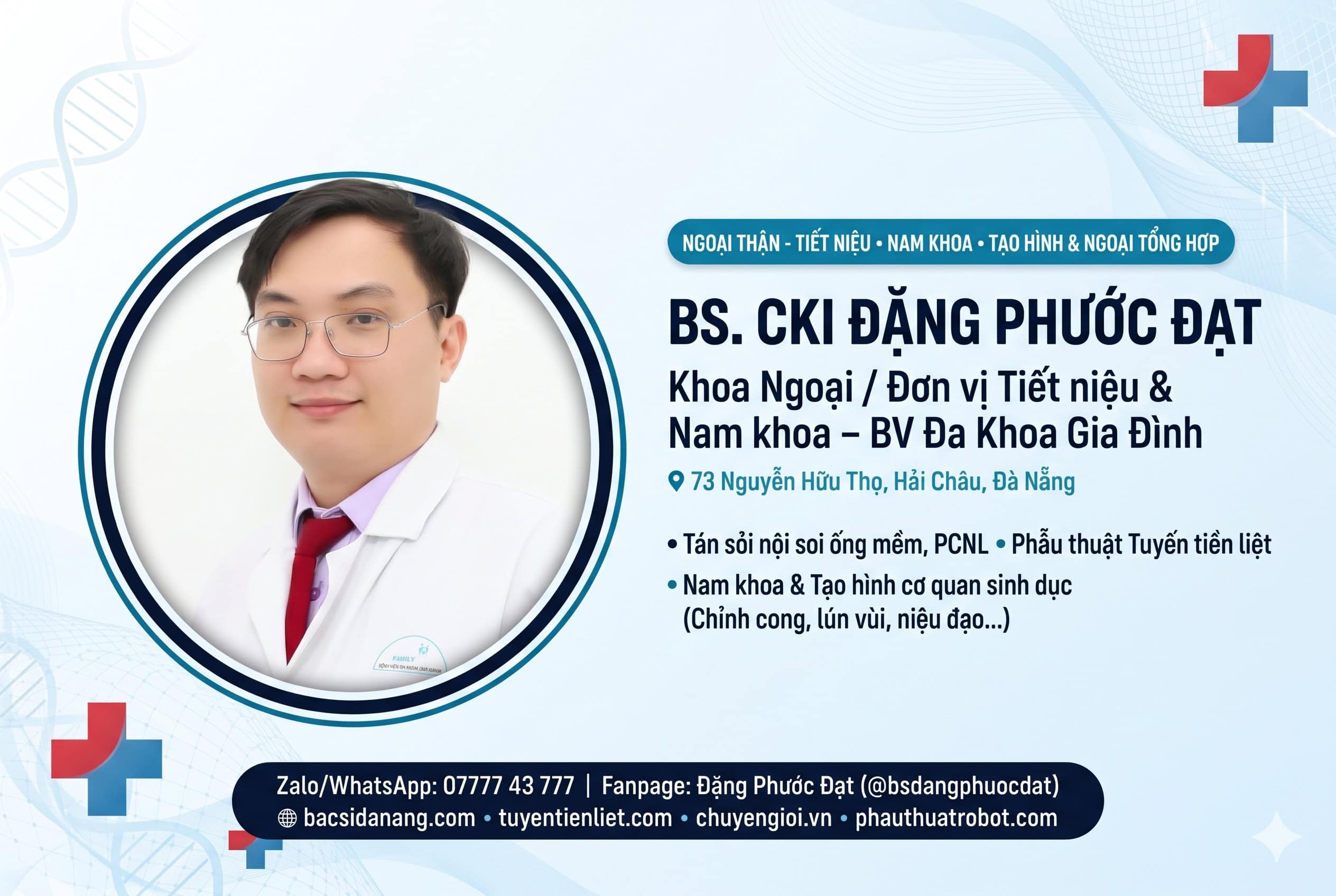
Author & Medical Reviewer: Dr. Dang Phuoc Dat, MD, Specialist Level I – Consultant Urologist, Andrologist & Reconstructive Surgeon (Family Hospital Da Nang & Private Clinic 162 Te Hanh)
Executive Clinical Summary: Significant penile curvature (> 30°) in adult men stems from either Congenital Penile Curvature (CPC) or Acquired Peyronie's Disease (PD) caused by fibrotic plaque in the tunica albuginea. Per 2026 European Association of Urology (EAU) guidelines, active-phase Peyronie's disease (< 12 months with painful erections) is treated non-surgically with daily Tadalafil 5 mg, Low-Intensity Shockwave Therapy (Li-ESWT), and traction, whereas stable curvature (≥ 3–6 months pain-free) is definitively corrected via neurovascular-sparing 16-Dot or Modified Nesbit Tunica Albuginea Plication [1, 2].
Experiencing a noticeable bend, indentation, or pain during erection can severely impact physical comfort, partner intimacy, and psychological confidence. For international residents, expats, and medical travelers in Central Vietnam, Dr. Dang Phuoc Dat, MD, Specialist Level I provides confidential, English-speaking diagnostic and reconstructive care at Family Hospital Da Nang and Private Clinic 162 Te Hanh. This clinical guide explains how to distinguish congenital asymmetry from Peyronie's plaque and outlines modern microsurgical correction options.
1. Congenital Penile Curvature (CPC) vs. Acquired Peyronie's Disease (PD)
A minor physiological curve of 10° to 15° is common and functionally benign. However, when angulation reaches 30° to 90°, causes difficulty with penetration, or leads to partner discomfort, identifying the underlying anatomical mechanism is the first clinical priority [1, 3]:
- Congenital Penile Curvature (CPC): Present since puberty due to asymmetric longitudinal development of the corpora cavernosa or corpus spongiosum. There is no scar tissue, no calcified plaque, and no pain during erection. The curve is most frequently ventral (downward) or lateral, and baseline erectile rigidity is typically strong [1].
- Acquired Peyronie's Disease (PD): Typically develops in men aged 40 to 70 following repetitive microvascular buckling trauma to the tunica albuginea during intercourse. Disordered wound healing driven by Transforming Growth Factor-Beta 1 (TGF-β1) replaces elastic fibers with inelastic type III collagen plaques or calcifications, pulling the erect shaft toward the scarred side (most commonly dorsal/upward) [2, 3].
🔬 Two-Phase Clinical Staging of Peyronie's Disease (EAU/AUA Guidelines)
| Clinical Stage | Pathophysiological Hallmarks | Evidence-Based Management Protocol |
|---|---|---|
| Phase 1: Active Inflammatory Stage (0 – 12 Months) | Painful erections, soft/immature plaque, and a curvature angle that is still actively changing. | Surgery is contraindicated. Treat with daily Tadalafil 5 mg (antifibrotic), focused Li-ESWT for pain relief, and penile traction [1, 2]. |
| Phase 2: Stable Fibrotic Stage (> 12 Months) | Complete resolution of erectile pain and a stable, unchanging curvature angle for ≥ 3 to 6 months. | Definitive Surgical Reconstruction (16-Dot Tunica Plication, Modified Nesbit, or Plaque Incision & Grafting) [1, 4]. |
2. Comparing Surgical & Non-Surgical Penile Curvature Treatments in Da Nang
Selecting the right corrective technique depends on four objective clinical parameters: curvature angle (degrees), presence of hourglass/hinge deformity, baseline stretched penile length, and erectile rigidity (IIEF-5 score) [1, 4]:
| Treatment Modality | Primary Clinical Indication | Key Surgical / Technical Mechanism | Expected Outcome & Recovery |
|---|---|---|---|
| 1. Multimodal Active-Phase Therapy (Tadalafil + Li-ESWT) | Active Peyronie's disease (< 12 months) with painful erections or mild curvature (< 30°). | Low-intensity shockwaves reduce nociceptor pain signaling while daily PDE5i inhibits myofibroblast collagen deposition. | Rapid pain relief in 80%–85% of patients and stabilization of plaque progression; zero downtime [1]. |
| 2. 16-Dot / Lue Tunica Albuginea Plication | Congenital curvature or stable Peyronie's curvature (30° – 60°) with normal erectile rigidity and adequate length. | Incision-free placement of buried, inverted non-absorbable sutures along the convex side beneath Buck's fascia [3]. | 92%–96% complete functional straightening (< 10° residual), minimal risk of ED or sensory change; 6-week healing [3, 4]. |
| 3. Modified Nesbit / Yachia Corporate Corporoplasty | Thick-tunica congenital curvature or stable 45° – 65° angulation requiring high-tensile fusion. | Superficial elliptical excisions or longitudinal incisions closed horizontally (Heineke-Mikulicz principle) on the convex side. | Permanent anatomical fusion with < 5% recurrence rate; 1-night hospital stay at Family Hospital Da Nang [1]. |
| 4. 3-Piece Inflatable Penile Prosthesis (IPP) + Modeling | Peyronie's curvature co-existing with severe, medication-refractory Erectile Dysfunction (ED). | Simultaneous implantation of a concealed hydraulic 3-piece prosthesis with intraoperative Wilson plaque modeling [4]. | Restores both axial rigidity and straight alignment in a single definitive procedure [1, 4]. |
3. Neurovascular Bundle Preservation & Intraoperative Artificial Erection Testing
To achieve millimeter-level symmetry while protecting glans sensation and erectile hemodynamics, Dr. Dang Phuoc Dat follows a standardized 4-step microsurgical protocol at Family Hospital Da Nang:
- Pre-Operative 3D Angle Verification & Penile Duplex Ultrasound: Evaluates plaque dimensions, rules out calcified septal involvement, and measures peak systolic velocity (PSV > 30 cm/s) of the cavernous arteries.
- Intraoperative Saline Artificial Erection (Gittes Test): Sterile saline is infused into the corpora cavernosa on the operating table to visualize the exact point of maximum curvature (Fulcrum) in real time.
- Microsurgical Preservation of the Dorsal Neurovascular Bundle (NVB) or Urethra: Using optical magnification, Buck's fascia is carefully elevated away from the dorsal sensory nerves (for ventral curvature) or the corpus spongiosum/urethra (for dorsal curvature) before placing buried inverted sutures [3, 4].
- Real-Time Straightness Confirmation: A repeat saline erection confirms a completely straight shaft (< 5°–10° physiological tolerance) before layered anatomical closure.
🚨 Clinical Red Flags Requiring Immediate Urological Assessment
- Suspected Penile Fracture (Emergency): An audible “pop” or cracking sound during intercourse followed by immediate loss of erection, severe pain, and dark purple swelling (“eggplant deformity”) requires emergency surgical repair within hours to prevent permanent severe curvature and ED.
- Rapidly Progressing Curvature or Induration: Any new firm lump or plaque on the shaft accompanied by painful erections should be evaluated early during the active window when medical/shockwave therapy is most effective.
4. Frequently Asked Questions (FAQ)
Question 1: Does 16-Dot tunica plication surgery shorten the penis?
Tunica plication works by gently shortening the longer (convex) side of the shaft to match the shorter (concave) side. Geometrically, this results in approximately 1 to 1.5 mm of length adjustment per 10 degrees of curvature corrected (typically 0.5 to 1.0 cm total for moderate curves). Because a curved penis already loses functional axial length, over 90% of patients perceive their post-operative erect length as functionally equal or superior once straight alignment is restored [1, 3].
Question 2: Will I or my partner feel the internal stitches under the skin?
Dr. Dang Phuoc Dat employs a buried, inverted suture knot technique placed deep beneath Buck's fascia and the Dartos layer. Combined with modern braided low-profile sutures, palpable knots under the skin are minimized while maintaining lifelong straightening strength [3].
Question 3: What is the recovery timeline for expats or travelers visiting Da Nang for surgery?
The procedure takes 45 to 60 minutes under spinal or general anesthesia with a 24-hour inpatient stay at Family Hospital Da Nang. Desk work and light walking resume within 3 to 5 days, a follow-up wound check occurs at Day 7, gym workouts resume at 3 weeks, and sexual intercourse is safely resumed at 6 weeks post-operatively [1, 4].
5. Clinical References (Vancouver Style)
- Salonia A, Bettocchi C, Capogrosso P, Carvalho J, Corona G, Hatzichristodoulou G, et al. EAU Guidelines on Sexual and Reproductive Health: Penile Curvature. Arnhem, The Netherlands: European Association of Urology; 2026.
- Nehra A, Alterowitz R, Culkin DJ, Faraday MM, Hakim LS, Heidelbaugh JJ, et al. Peyronie's Disease: AUA Guideline. J Urol. 2015;194(3):745-753.
- Gholami SS, Lue TF. Correction of penile curvature using the 16-dot plication technique: a review of 132 patients. J Urol. 2002;167(5):2066-2069.
- Chung E, Ralph D, Kagioglu A, Garaffa G, Shamsodini A, Bivalacqua T, et al. Evidence-based management guidelines on Peyronie's disease. J Sex Med. 2016;13(6):905-923.
Medical Disclaimer: This clinical guide is provided for educational purposes and does not replace an in-person diagnostic evaluation and duplex ultrasound with a board-certified urologist and andrologist.
Dr. Dang Phuoc Dat, MD, Specialist Level I – Consultant Urologist, Andrologist & Reconstructive Surgeon (10+ years clinical experience).
📞 Hotline / Zalo / WhatsApp: +84 777 743 777 | WhatsApp Direct: wa.me/84777743777 | Websites: bacsidanang.com & tuyentienliet.com
Select any symptoms you are currently experiencing to see your recommended clinical triage level before messaging Dr. Dang Phuoc Dat:
