

 Holmium laser lithotripsy in Da Nang with Dr. Dang Phuoc Dat: 07777 43 777.)
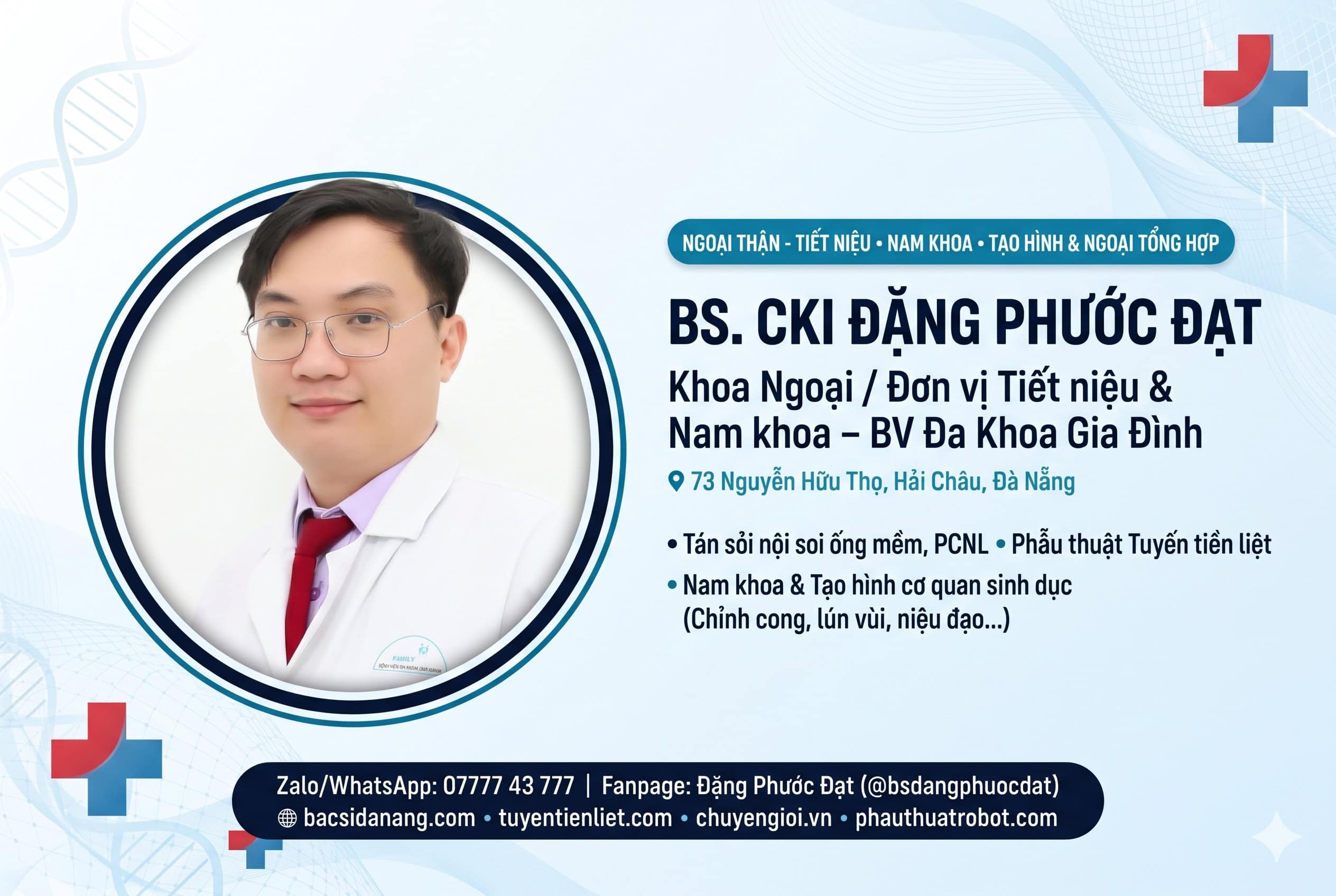
Author & Medical Reviewer: Dr. Dang Phuoc Dat, MD, Specialist Level I in Urology, Andrology & Reconstructive Surgery (Department of Surgery – Family Hospital Da Nang)
Executive Clinical Summary: Retrograde Intrarenal Surgery (RIRS) using a digital flexible ureteroscope and high-power Holmium:YAG laser lithotripsy coupled with a Flexible and Navigable Suction Ureteral Access Sheath (FANS) is the gold-standard, 100% incision-free procedure for renal and proximal ureteral stones up to 20 mm (and selected stones > 20 mm). By advancing an ultra-thin flexible scope through the body’s natural urinary tract without any skin incision, RIRS pulverizes kidney stones into sub-millimeter dust and actively aspirates fragments in real time, achieving a 90%–95% single-session stone-free rate (SFR), near-zero bleeding risk, and rapid 24-hour hospital discharge for international patients and expats in Da Nang, Vietnam.
1. What Is Retrograde Intrarenal Surgery (RIRS) With Suction Access Sheath (FANS)?
Retrograde Intrarenal Surgery (RIRS) is an advanced endourological technique that treats stones inside the renal pelvis and calyces (upper, middle, and lower poles) entirely through the natural orifice (urethra → bladder → ureter → kidney) [1]. Unlike percutaneous nephrolithotomy (PCNL), which requires a puncture through the flank and renal parenchyma, RIRS leaves zero external scars and preserves 100% of renal cortical tissue [2].
At the Department of Surgery – Family Hospital Da Nang, Dr. Dang Phuoc Dat, MD, Specialist Level I integrates two modern technological breakthroughs into every RIRS procedure:
- High-Frequency Holmium:YAG Laser Dusting & Pop-Corning: Utilizing low pulse energy (0.2–0.5 J) and high frequency (30–60 Hz) through a flexible 200-micron laser fiber to vaporize hard calcium oxalate monohydrate stones into fine powder (< 250 µm) [3].
- Flexible and Navigable Suction Ureteral Access Sheath (FANS): Traditional RIRS relied on passive spontaneous passage of stone dust over several weeks. With FANS continuous negative-pressure suction, the tip of the sheath bends directly into the renal calyces alongside the flexible scope, evacuating stone dust immediately while keeping intrarenal pelvic pressure safely below 15–20 mmHg to prevent pyelovenous backflow and postoperative fever [4].
CLINICAL DECISION MATRIX: WHEN TO CHOOSE RIRS VS. ESWL VS. MINI-PCNL (EAU GUIDELINES)
| Stone Size & Location | Key Anatomical & Clinical Factors | Recommended Modality by Dr. Dang Phuoc Dat |
|---|---|---|
| Renal Pelvis / Upper or Middle Calyx Stones (10 – 20 mm) | Including hard stones (> 1,000 HU on CT), obese patients, or patients on anticoagulation. | First-Line: Flexible Ureteroscopy (RIRS + FANS) for 92%+ single-procedure clearance without incisions [1]. |
| Lower Pole Renal Stones (10 – 20 mm) | Steep infundibulopelvic angle (< 30°) or narrow infundibulum where ESWL fragments fail to clear. | RIRS (with Nitinol basket relocation to upper calyx) or Mini-PCNL depending on calyceal neck width [5]. |
| Multiple Unilateral or Bilateral Kidney Stones (< 20 mm) | Stones scattered across multiple calyces in one or both kidneys. | Simultaneous Bilateral RIRS (SB-RIRS) using 270° active deflection digital ureteroscope [2]. |
2. 4-Column Comparison: RIRS With Suction (FANS) vs. ESWL vs. Mini-PCNL
| Clinical Parameter | Flexible Ureteroscopy (RIRS + FANS) | Shockwave Lithotripsy (ESWL) | Mini-PCNL (16Fr–18Fr) |
|---|---|---|---|
| Surgical Access | 100% Natural Orifice (No skin cut, no renal puncture). | External acoustic shockwaves. | 5 mm flank keyhole tract through renal parenchyma. |
| Efficacy on Hard Stones (> 1,000 HU) | Excellent (90%–95% SFR); Holmium laser fragments all stone compositions [6]. | Low (< 50% for stones > 1,000 HU or lower pole); often requires 2–3 sessions. | Highest (92%–96% SFR), ideal for stones > 20 mm or staghorn calculi. |
| Hospital Stay & Flight Readiness | 24 hours; patients resume work or travel within 2–3 days. | Outpatient, but risk of “Steinstrasse” (ureteral stone street colic) during travel. | 2–3 days inpatient stay; avoid heavy lifting for 2 weeks. |
| Bleeding Risk | Virtually zero; safe even for patients with coagulopathy [1]. | Risk of subcapsular perirenal hematoma (especially in hypertension). | Low (< 1.5% transfusion rate with Mini-PCNL). |
3. Step-by-Step RIRS Surgical Pathway for Expats at Family Hospital Da Nang
Step 1 – Non-Contrast Low-Dose CT KUB & Pre-Stenting Assessment
Every patient undergoes a high-resolution CT scan to measure stone dimensions, Hounsfield density (HU), and ureteral caliber. In approximately 85%–90% of adult patients, the flexible access sheath (10/12Fr or 11/13Fr) can be placed primary in a single procedure; only patients with a congenitally narrow ureteral orifice require temporary pre-stenting for passive ureteral dilation [3].
Step 2 – Digital Flexible Ureteroscopy, Laser Dusting & Suction Evacuation
Under spinal or general anesthesia, Dr. Dang Phuoc Dat navigates the digital flexible ureteroscope through the FANS sheath into every renal calyx. Stones in the lower pole are repositioned into the upper calyx using a zero-tip Nitinol basket to protect the scope’s deflection mechanism and maximize laser efficiency, followed by complete dust aspiration [4].
⚠️ RED FLAGS: WHEN TO SEEK EMERGENCY UROLOGICAL CARE
If you have a known kidney or ureteral stone and develop (1) High fever (> 38.5°C / 101.3°F) with chills or rigors; (2) Unrelenting flank pain accompanied by persistent vomiting; (3) Gross hematuria with blood clots; or (4) Decreased urine output (oliguria/anuria), seek immediate hospital evaluation to rule out obstructive pyelonephritis and urosepsis.
4. Frequently Asked Questions (FAQ) About RIRS in Da Nang
Q1: Will I need a Double-J stent after RIRS, and for how long?
Answer: Because FANS suction removes virtually all stone dust during surgery, mucosal edema is minimal. When a soft silicone Double-J stent is placed to prevent transient ureteral spasm, it is typically kept for only 7 to 14 days and removed painlessly in 2 minutes using a flexible cystoscope.
Q2: Can international travel insurance or direct billing cover RIRS at Family Hospital Da Nang?
Answer: Yes. Family Hospital Da Nang provides full English medical documentation, itemized surgical reports, CT imaging DICOM files, and direct billing support for major international health and travel insurance providers.
Medical References (Vancouver Style)
- Inoue T, Okada S, Hamamoto S, Fujisawa M. Retrograde intrarenal surgery: Past, present, and future. Investig Clin Urol. 2021;62(2):121-135. (NCBI PMC)
- Recent advances in the treatment of renal stones using flexible ureterorenoscopy. Int J Surg / PMC. 2024;110(7):4320-4328. (NCBI PMC)
- Sanguedolce F, Bozzini G, et al. Retrograde intrarenal surgery for renal stones – Part 1. Turk J Urol. 2017;43(2):107-114. (NCBI PMC)
- The Prime Time for Flexible Ureteroscopy for Large Renal Stones Is Coming: Suction Ureteral Access Sheath. Urol Res Pract / PMC. 2023. (NCBI PMC)
- Comparison of retrograde flexible ureteroscopy and percutaneous nephrolithotomy for lower pole stones. Int Braz J Urol. 2019;45(1):10-19. (NCBI PMC)
- Efficacy of flexible fibreoptic ureteroscopy and Holmium laser in retrograde intrarenal surgery for calyceal calculi. Indian J Urol / PMC. 2016. (NCBI PMC)
Select any symptoms you are currently experiencing to see your recommended clinical triage level before messaging Dr. Dang Phuoc Dat:

ĐẦU TƯ NGHIÊM TÚC