Trang chủ Urology & Kidney Stone Surgery Endoscopic Kidney Stone Removal Da Nang: Options & Costs – Dr. Dat

Endoscopic Kidney Stone Removal Da Nang: Options & Costs – Dr. Dat

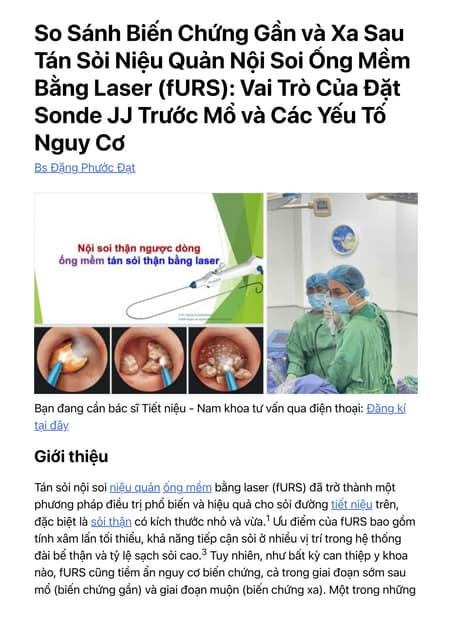
Endoscopic kidney stone removal modalities in Da Nang performed by Dr. Dang Phuoc Dat
Individualized endoscopic stone surgery (URS, RIRS, Mini-PCNL) maximizes stone-free rates while minimizing hospitalization to 1–4 days.
Bạn đang cần bác sĩ Tiết niệu - Nam khoa tư vấn qua điện thoại: Đăng kí tại đây
Đánh giá nội dung:

Author & Medical Reviewer: Dr. Dang Phuoc Dat (Specialist Level I) – Urology, Andrology & Reconstructive Surgery, Family Hospital Da Nang | Updated: October 22, 2026

When conservative medical therapy fails to pass a urinary calculus, endoscopic kidney stone removal Da Nang encompasses four distinct minimally invasive procedures that have replaced over 95% of traditional open surgeries. Understanding how each endoscopic technique matches your stone’s exact location, millimeter size, and CT hardness empowers you to make an informed decision with your urologist.

Quick Clinical Summary: Modern endoscopic kidney stone removal relies on four targeted modalities: Semi-Rigid Ureteroscopy (URS) for distal/mid-ureteral stones; Flexible Ureteroscopy (RIRS) via the natural urinary tract for renal stones $\le 20\text{ mm}$; Mini-PCNL via a $5\text{ mm}$ flank tract for renal stones $> 20\text{ mm}$; and Retroperitoneal Laparoscopy for giant solitary extrarenal pelvic or ureteral stones. At Family Hospital Da Nang, Dr. Dang Phuoc Dat performs all four techniques.

Endoscopic kidney stone removal modalities in Da Nang performed by Dr. Dang Phuoc Dat
Individualized endoscopic stone surgery (URS, RIRS, Mini-PCNL) maximizes stone-free rates while minimizing hospitalization to 1–4 days.

1. The Four Pil>1. The Four Pillars of Endoscopic Kidney & Ureteral Stone Surgery

-block-paragraph">In contemporary urology, minimally invasive stone surgery is divided into Endourology (natural-orifice or miniature intrarenal lumina) and Retroperitoneal Laparoscopy:

  1. Semi-Rigid Ureteroscopy (URS): Passes a slender endoscope through the urethra and bladder into the ureter to fragment distal and mid-ureteral stones with a Holmium laser.
  2. Retrograde Intrarenal Surgery (RIRS): Uses a steerable digital flexible ureteroscope to navigate into the upper ureter and renal calyces, dusting stones $< 20\text{ mm}$ with zero external incisions.
  3. Mini-Percutaneous Nephrolithotomy (Mini-PCNL): Establishes a $5\text{ mm}$ keyhole flank tunnel directly into the kidney to clear stones $> 20\text{ mm}$ or staghorn calculi.
  4. Retroperitoneal Laparoscopic Pyelolithotomy / Ureterolithotomy: Uses three small $5–10\text{ mm}$ retroperitoneal ports to extract an intact giant calculus ($> 25\text{ mm}$) from an extrarenal pelvis or upper ureter, followed by intracorporeal absorbable suturing.

EAU Clinical Deci>EAU Clinical Decision Matrix for Endoscopic Stone Surgery in Da Nang

"wp-block-table">
Stone Location & SizeFirst-Line ModalityAlternative ModalityTypical Hospital Stay
Renal Stone $< 10\text{ mm}$ (symptomatic)Shockwave Lithotripsy (ESWL) or Flexible RIRSActive surveillance if asymptomatic & non-obstructingDay-case – 24 hours
Renal Stone $10 – 20\text{ mm}$Flexible Ureteroscopy (RIRS) or Mini-PCNLESWL (only if soft $< 1000\text{ HU}$ and favorable calyx)1 – 3 days
Renal Stone $> 20\text{ mm}$ / StaghornUltrasound-Guided Mini-PCNLRetroperitoneal Laparoscopy or staged RIRS3 – 4 days
Ureteral Stone $> 7\text{ mm}$ with HydronephrosisSemi-Rigid URS (distal/mid) or Flexible RIRS (proximal)Mini-PCNL or Laparoscopic Ureterolithotomy (if $> 15\text{ mm}$ impacted)1 – 2 days
EAU Clinical Decision Matrix for Endoscopic Stone Surgery in Da Nang
INTERNATIONAL CLINICAL CARE PATHWAY • BACSIDANANG.COM ENDOSCOPIC KIDNEY STONE REMOVAL DA NANG 1. PRECISION DIAGNOSTICS • Specialist 1-on-1 Evaluation • High-Res CT / Doppler Imaging • EAU / AUA Risk Stratification Endourological Stone Surgery 2. PERSONALIZED THERAPY • Minimally Invasive Priority • Organ & Nerve Preservation • Strict Sterile OR Standards Semi-Rigid Ureteroscopy (URS) 3. RECOVERY & INSURANCE • Rapid Return to Travel/Work • Direct Insurance Billing • Long-Term Recurrence Prevention Retrograde Intrarenal Surgery (RIR Medical Reviewer: Dr. Dang Phuoc Dat (Specialist Level I) • Family Hospital Da Nang • WhatsApp/Zalo: +84 919 480 180
Clinical diagnosis and treatment pathway for “endoscopic kidney stone removal Da Nang” – Dr. Dang Phuoc Dat, Family Hospital Da Nang.

2. Why Preoperative CT Urography Is Mandatory Before >2. Why Preoperative CT Urography Is Mandatory Before Endoscopic Stone Surgery

at Family Hospital Da Nang, Dr. Dang Phuoc Dat requires a non-contrast or contrast-enhanced CT Urography scan prior to scheduling any endoscopic stone removal:

  • Accurate 3D Stone Burden Measurement: Ultrasound acoustic shadowing frequently overestimates or underestimates stone size by 20–30%.
  • Hounsfield Unit (HU) Hardness Profiling: Stones measuring $> 1000–1200\text{ HU}$ (such as Calcium Oxalate Monohydrate or Brushite) are resistant to external shockwaves and require high-power Holmium laser fibers.
  • Anatomical Roadmap: Detects congenital anomalies such as horseshoe kidney, duplex collecting systems, or ureteropelvic junction obstruction (UPJO) prior to scope insertion.
endoscopic kidney stone removal Da Nang - Dr. Dang Phuoc Dat
Evidence-based clinical algorithm for Endoscopic Kidney Stone Removal (URS, RIRS, Mini-PCNL) at Family Hospital Da Nang.

3. Transparent Cost Structure for Endoscopic Stone Surger>3. Transparent Cost Structure for Endoscopic Stone Surgery in Da Nang

doscopic stone removal at Family Hospital Da Nang are itemized transparently across four components:

  • Preoperative Diagnostics & Anesthesia Workup: Complete blood count, coagulation profile, renal function (eGFR), urine culture, ECG, chest X-ray, and CT Urography.
  • Surgical & Anesthesia Fees: Scaled according to technical complexity (semi-rigid URS is the most economical, followed by Mini-PCNL and digital flexible RIRS).
  • Endourological Consumables: Holmium laser fiber, Nitinol extraction basket, ureteral access sheath (UAS), and internal Double-J Ureteral Stent.
  • Inpatient Room & Medications: Optimized by short 1–4 day hospital stays and eligible for both Vietnamese BHYT and international health insurance direct billing.

Clinical Red Flags: When to Seek Immediate Urological Care<>Clinical Red Flags: When to Seek Immediate Urological Care

und-color:#fff5f5;border-left-color:#d32f2f;border-left-width:4px;padding-top:16px;padding-right:20px;padding-bottom:16px;padding-left:20px">

URGENT MEDICAL RED FLAGS:

  • Renal colic accompanied by fever (> 38.5°C), chills, cloudy foul-smelling urine, or hypotension: Definitive laser lithotripsy is strictly contraindicated during acute infected hydronephrosis; emergency decompression via Double-J stenting or percutaneous nephrostomy must be performed first.
  • Persistent gross hematuria or inability to void after discharge warrants immediate review.

Clinical Perspective from Da Nang: Many patients with Grade III–IV hydronephrosis from an impacted ureteral stone delay endoscopic surgery because their flank pain has subsided. In urological physiology, once chronic obstruction stretches the renal capsule to its limit and exhausts ureteral peristalsis, colic pain disappears even as irreversible nephron loss accelerates during this ‘silent obstructive phase.’

- Nhà tài trợ nội dung -

Frequently Asked Questions (International Patient Guide)

>Frequently Asked Questions (International Patient Guide)idney stone procedure has the least postoperative pain?

Flexible Ureteroscopy (RIRS) and Semi-Rigid Ureteroscopy (URS) cause the least discomfort because the endoscope travels entirely through the natural urinary tract without any skin or muscle incisions.

Question 2: Can bilateral kidney stones (stones in both kidney>Question 2: Can bilateral kidney stones (stones in both kidneys) be treated in a single surgery?

ents with moderate bilateral stone burden and sterile urine, simultaneous bilateral endoscopic stone removal (or combined RIRS + Mini-PCNL) can be safely performed, or the more obstructed kidney is prioritized first.

Question 3: When can I resume gym workouts or swimming after e>Question 3: When can I resume gym workouts or swimming after endoscopic stone removal?

tent remains in place (typically 2–4 weeks), stick to light walking and avoid running, heavy lifting, or vigorous sports, as stent friction against the bladder trigone causes urinary urgency and pink urine. One week after stent removal, you can resume full athletic activity.

Clinical References & International Guidelines

    Clinical References & International Guidelines Urology (EAU): EAU Guidelines on Urolithiasis, Management of Non-Neurogenic Male LUTS, Sexual and Reproductive Health, and Prostate Cancer (2025–2026 Edition).
  1. American Urological Association (AUA): AUA Clinical Practice Guidelines on Kidney Stones, Benign Prostatic Hyperplasia (BPH), Erectile Dysfunction, and Peyronie’s Disease.
  2. Ministry of Health of Vietnam: National Clinical Guidelines on Diagnosis and Treatment in Urology and Andrology.
  3. International Society for Sexual Medicine (ISSM) & WPATH: Standards of Care for the Health of Transgender and Gender Diverse People, Version 8 (SOC-8).

Medical Disclaimer: This clinical guide is authored and medically reviewed by Dr. Dang Phuoc Dat (Specialist Level I in Urology & Andrology) based on current international urological guidelines for patient education. It does not substitute for an in-person clinical examination, diagnostic imaging, or individualized surgical consultation.

International Patient Consultation & Booking in Da Nang, Vietn>International Patient Consultation & Booking in Da Nang, Vietnam

rong> Dr. Dang Phuoc Dat (Bs CKI Đặng Phước Đạt) – Specialist Level I in Urology, Andrology & Reconstructive Plastic Surgery
  • Hospital Practice: Department of Surgery – Family Hospital Da Nang (73 Nguyen Huu Tho Street, Hai Chau District, Da Nang City, Vietnam)
  • Direct WhatsApp / Zalo / Hotline (English & Vietnamese): +84 919 480 180
  • Email: bsdangphuocdat@gmail.com
  • Medical Portals: bacsidanang.com | tuyentienliet.com | chuyengioi.vn | phauthuatrobot.com
  • { “@context”: “https://schema.org”, “@graph”: [ { “@type”: “MedicalWebPage”, “@id”: “https://bacsidanang.com/endoscopic-kidney-stone-removal-da-nang/#webpage”, “url”: “https://bacsidanang.com/endoscopic-kidney-stone-removal-da-nang/”, “name”: “Endoscopic Kidney Stone Removal Da Nang: Options & Costs – Dr. Dat”, “description”: “Compare endoscopic kidney stone removal in Da Nang (URS, RIRS, Mini-PCNL, Laparoscopy) with Dr. Dang Phuoc Dat at Family Hospital. Call/WhatsApp: +84919480180.”, “inLanguage”: “en-US”, “datePublished”: “2026-10-22”, “dateModified”: “2026-10-22”, “lastReviewed”: “2026-10-22”, “primaryImageOfPage”: { “@type”: “ImageObject”, “url”: “https://bacsidanang.com/wp-content/uploads/2026/10/sosanhbienchungganvaxasautansoinieuquannoisoiongmembanglaserfursvaitrocuaatsondejjtruocmovacacyeuton-250725045550-43a9fe10-thumbnail-1.jpg”, “caption”: “Individualized endoscopic stone surgery (URS, RIRS, Mini-PCNL) maximizes stone-free rates while minimizing hospitalization to 1–4 days.” }, “medicalAudience”: { “@type”: “MedicalAudience”, “audienceType”: “Patient” }, “author”: { “@type”: “Physician”, “name”: “Dr. Dang Phuoc Dat (Bs CKI Dang Phuoc Dat)”, “jobTitle”: “Specialist Level I in Urology, Andrology & Reconstructive Surgery”, “url”: “https://bacsidanang.com/urologist-in-da-nang/”, “sameAs”: [ “https://familyhospital.vn/profile/dang-phuoc-dat/”, “https://bacsidanang.com/bac-si-than-tiet-nieu-da-nang/”, “https://bacsidanang.com/ultrasound-guided-mini-pcnl-with-laser-lithotripsy-minimally-invasive-kidney-stone-treatment-in-da-nang/”, “https://chuyengioi.vn/author/chuyengioi/”, “https://www.slideshare.net/PhuocDatYC” ], “worksFor”: { “@type”: “Hospital”, “name”: “Family Hospital Da Nang (Bệnh viện Đa khoa Gia Đình Đà Nẵng)”, “address”: { “@type”: “PostalAddress”, “streetAddress”: “73 Nguyen Huu Tho Street, Hai Chau District”, “addressLocality”: “Da Nang”, “addressCountry”: “VN” }, “telephone”: “+84919480180” } }, “reviewedBy”: { “@type”: “Physician”, “name”: “Dr. Dang Phuoc Dat”, “url”: “https://familyhospital.vn/profile/dang-phuoc-dat/” } }, { “@type”: “FAQPage”, “@id”: “https://bacsidanang.com/endoscopic-kidney-stone-removal-da-nang/#faq”, “mainEntity”: [ { “@type”: “Question”, “name”: “Which endoscopic kidney stone procedure has the least postoperative pain?”, “acceptedAnswer”: { “@type”: “Answer”, “text”: “Flexible Ureteroscopy (RIRS) and Semi-Rigid Ureteroscopy (URS) cause the least discomfort because the endoscope travels entirely through the natural urinary tract without any skin or muscle incisions.” } }, { “@type”: “Question”, “name”: “Can bilateral kidney stones (stones in both kidneys) be treated in a single surgery?”, “acceptedAnswer”: { “@type”: “Answer”, “text”: “In selected medically fit patients with moderate bilateral stone burden and sterile urine, simultaneous bilateral endoscopic stone removal (or combined RIRS + Mini-PCNL) can be safely performed, or the more obstructed kidney is prioritized first.” } }, { “@type”: “Question”, “name”: “When can I resume gym workouts or swimming after endoscopic stone removal?”, “acceptedAnswer”: { “@type”: “Answer”, “text”: “While your internal Double-J stent remains in place (typically 2–4 weeks), stick to light walking and avoid running, heavy lifting, or vigorous sports, as stent friction against the bladder trigone causes urinary urgency and pink urine. One week after stent removal, you can resume full athletic activity.” } } ] } ] }

    BÌNH LUẬN

    Vui lòng nhập bình luận của bạn
    Vui lòng nhập tên của bạn ở đây